“BLACK AND -“

February 10 – April 7, 2012

Robert Blackburn, Seymour Boardman, Ernest Briggs, Perez Celis, Amaranth Ehrenhalt, Claire Falkenstein, Agustin Fernandez, Perle Fine, John Hultberg, Ward Jackson, Buffie Johnson, William Manning, Henri Michaux, Luise Nevelson, Misha Reznikoff, Richards Ruben, Aaron Siskind, Antoni Tapies, Petra Valentova and Wilfrid Zogbaum.

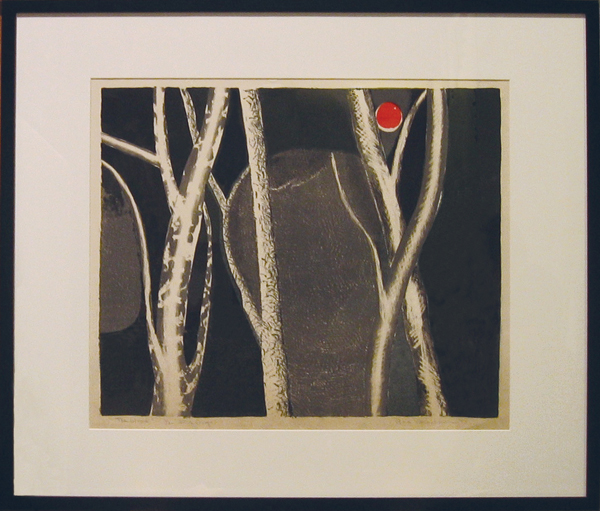
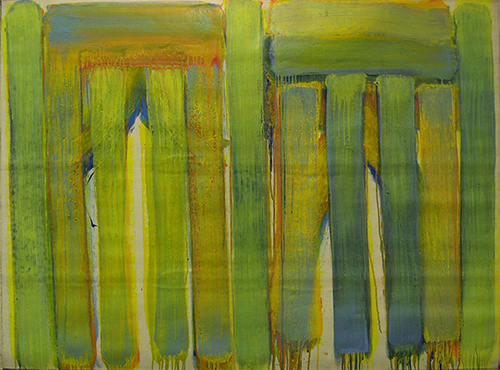
The Anita Shapolsky Gallery presents “Black and -” a theme using the color black to connect various abstract paintings, sculpture and paper works from the diverse collection. The color black is traditionally used to create shadow, chiaroscuro, and to highlight negative space. Abstract artists reinvented this academic tradition by including the color to create positive space and to create ambiguity between figure and ground, making a distinction between the two difficult to discern. This exhibit will showcase the different ways artists used this powerful color.

Three Decades of Ernest Briggs’ Abstract Expressionist Paintings

April 17 – August 2012

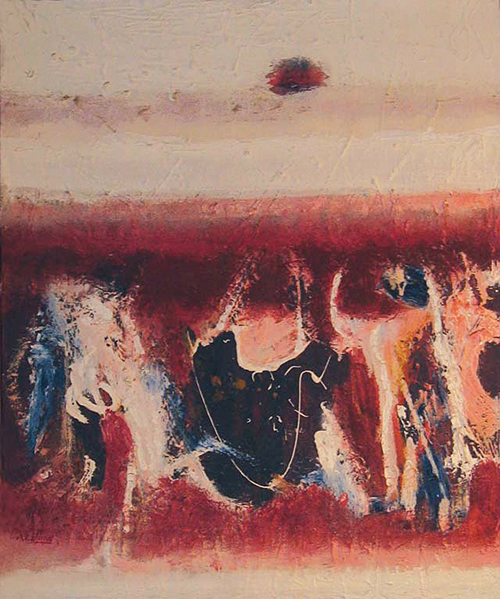
A native of San Diego, Briggs studied at the California School of Fine Arts in San Francisco (1946-47), the first independent art school outside of New York, where Douglas MacAgy brought together a remarkable faculty including Mark Rothko, Ad Reinhardt, David Park and Clyfford Still. Their influence, in particular, that of his mentor and friend, Still’s visionary aspirations, remained with him for life. In the early 1950s Briggs was pulled along with the Californian diaspora to New York. Almost immediately he was given a one-man show at the Stable Gallery. He developed the rugged California aesthetic into sensual, refined and inviting explosions of paint. He was featured in the “Twelve Americans” exhibition in 1956 at the Museum of Modern Art, curated by Dorothy Miller.

“The discipline to free one’s image from the conventional aspects without surrendering the affirmative drama of human insight to the sterility of decoration or simple design problems has been, and I believe will be, my continuing direction.” (Ernest Briggs, 1956)

“His painting seems to be a process of thoughtful, ruminative adventure. Unlike many of his colleagues in idiom, he does not repeat himself. Each of his canvases strikes in a different direction, but most of them are admirably consistent and well integrated; if you think this type of painting invariably means an unleashed and unconsidered flinging of brushes and pigment, take a good, long look at Briggs and learn your errors.” (Alfred Frankenstein, The San Francisco Chronicle, 1949)

“From the contrast between the surface bravura and the half-seen abstract shapes, a surprising intimacy arises which is like seeing a public statue, thinking itself unobserved, move.” (Frank O’Hara, Art News, May 1954)

“There is a depth and dynamism in Ernest Briggs’ non-objective painting such as is seldom seen in these parts … they have a feeling of flood and sway, of a pouring of forces and tensions across the canvas field. It is as if, to use a slightly mixed metaphor, there were a great wind blowing through all his paintings. There is a kind of dynamism here which gives the effect of living, abstract gesture.” (Lawrence Ferlinghetti, 1953)

“The styl[e] of Briggs … in the fifties does bear a family resemblance to Still’s while differing substantially because of [his] more explicit references to nature, … greater lyricism, and … stress on painterly finesse.” (Irving Sandler, The New York School, 1978)


New York School Artists

August 2012 – January 12, 2013

Peter Agostini, Alcopley, Edward Avedisian, Seymour Boardman, Ilya Bolotowsky, Norman Bluhm, Ernest Briggs, Gandy Brodie, James Brooks, Peter Busa, Lawrence Calcagno, Herman Cherry, Friedel Dzubas, Jimmy Ernst, John Hultberg, Ruben Kadish, Aristodimos Kaldis, Frederick Kiesler, Albert Kotin, Ibram Lassaw, Michael Loew, Joan Mitchell, Louise Nevelson, Claes Oldenburg, Philip Pavia, Joe Stefanelli, Taro Yamamoto & Wilfrid Zogbaum

AVAILABLE, LIMITED SUPPLY
“The Artist’s World”, softcover edition, $20.00 +shipping
“The Artist’s World”, hardcover edition, $25.00 +shipping

This exhibition is based on the photo classic book, “The Artist’s World”, by Fred W. McDarrah and with text by Gloria S. McDarrah, which documents the New York School Action painters (which included all the avant guard creative, artistic people) in their environs. The first edition was published in 1961. The second edition, published in 1988, was dedicated “to the Artists and to Anita Shapolsky who made this edition possible”. There is an illuminating introduction by Thomas Hess (Art News).

Since I began my gallery in 1982, the older artists I met carried dog-eared copies of the original black and white covered book, which they constantly reminisced about in discussions. It’s a simply written book with three parts and sub-chapters: (1) A Way of Life, (2) Achieving Status and (3) A Definite Stand. The photographs of the artists living quarters, partying, drinking at the Cedar tavern, at the Club with guru Philip Pavia and mentor William Littlefield. This doesn’t make it an “art book” but a chronicle of the reality of the times these artists lived in (late 40′s/50′s). It showed many artistic people who were on the scene, struggling in a society that neglected and negated their efforts. Changes were evident in different areas that strengthened their resolve–Freud, jazz, poetry, criticism. The individual was respected by his peer group. These artists sustained each other and formed what we today call “support groups”.

Over the years, I have exhibited works of most of these artists and knew many of them. In the 80′s the avant guard artists were underground because galleries since the 60′s were exhibiting minimal, pop art, experiments with junk, and happenings due to societal changes–the commercial growth and greed of America, the Vietnam war and loss of faith.

Growing up with Abstract Expressionism, I elected to focus my gallery on these under-represented artists and Voilá!–they had a rebirth and are still being collected, studied and are competitive on the global scene. We also exhibited women artists who were rejected by their male counterparts and gallerists, as well as Latino and African American artists who faced the same treatment. I understood the soul (in the spirit of Martha Jackson and Betty Parsons) of Abstract Expressionism which came from the Depression, WWII and the anger towards society. That is why these artists kept away from political art, and searched within themselves. The artist was art.

The artists selected for this exhibition are not all “big” names, they are an interesting cross-section of the art world as pictured in the book.

The new vigorous movements of the contemporary art world are trying to express their feelings about the world they live in today. There is a coming together in many communities, that give young artists peer support and experience. Countries are also sharing their borders with new ideas from younger artists.

These artists hopefully will appreciate the trials and tribulations of the often rejected New York School Artists who created a great art movement–possibly the greatest. History will tell.

American Renaissance Art

January 26-March 16, 2013

The American Abstract Art movement was the epiphany of the individual. He was the center of the painting-of his universe. The art of the Abstract Expressionists is timeless, as has been proven by the auction world since the 50′s. There are other styles and movements, but none that can compare.

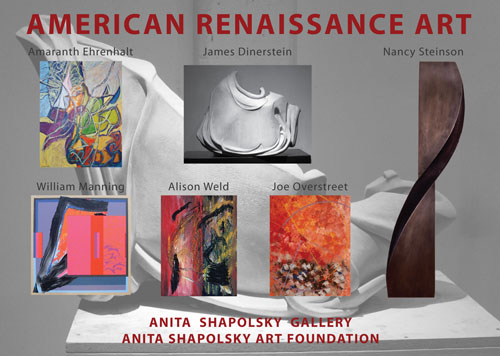
James Dinerstein. A New York native, Dinerstein graduated from Harvard. He studied with art historian and critic Michael Fried. He worked at St. Martin’s Art School in London with sculptors Anthony Caro and William Tucker. Dinerstein aims to restore the resources of plasticity and mass while manifesting the spiritual potency of Greek antiquity and musical polyphony. His recent work is more organic, primal, and overtly sensuous as it emerges from a deeper and freer source.

Amaranth Ehrenhalt. After 38 years in France and Italy, Ehrenhalt returned New York in 2008. In N.Y. during the 50′s she was friendly with Al Held, Ronald Bladen, and Willem de Kooning. She has exhibited with Sam Francis, Joan Mitchell, Shirley Jaffe and others in Paris. Ehrenhalt’s work expands beyond the canvas to include drawings, prints, watercolors, tapestries, mosaics, murals, sculptures, poetry, prose and more. In order to experience the surprises and treasures of Ehrenhalt’s art, it must be seen and digested by the viewer.

William Manning. Manning began working in black and white before moving on to collage. His paper pieces are the foundation of his work and are based on the environment of his native Maine. The subject for his delicate line drawing and expressive collage is the cycling of nature, including the seasons, weather, and the sun’s light. After 1975, he transitioned from flat to three-dimensional standing and wall paintings that allowed for multiple viewpoints. His newer work of collage on panels uses his boldest, richest colors combined with an array of gestural and geometric elements.

Joe Overstreet. Born in Conehatta, Mississippi, Overstreet’s family migrated to San Francisco. He attended the San Francisco Art institute under the mentorship of Sargent Johnson. He moved to New York in 1958 and was incorporated into the New York School as one of its younger members alongside Norman Lewis, Hale Woodruff, and Romare Bearden. His work thematically challenges dimensional boundaries. Overstreet experimented with steel mesh and wire, combining and unraveling them with paint in a reference to the human condition. His new work is more sublime.

Nancy Steinson. Born in Louisville, Kentucky, Steinson came to New York and became an abstractionist influenced by Constantin Brancusi, Barbara Hepworth, and Ben Nicholson. Liberating, purely geometric structures expressing movement, direction, space and scale characterize her art. Her work is almost exclusively, except in works on paper, formed with curved planar forms and linear straight edges which suggest a more organic approach to form as opposed to the industrial purity of early minimalism.

Alison Weld. Weld’s paintings exude a passionate and visceral, yet clearly informed visual intelligence. In each mark and gestural working of the paint, she manifests a personal presence calculated to engage the viewer in a process of discovery. Each of her paintings makes an individualized statement while referencing others. The totality of artistic tension and resolution throughout her body of work points to the complexities of the world we all live in.