A Non-Objective Couple

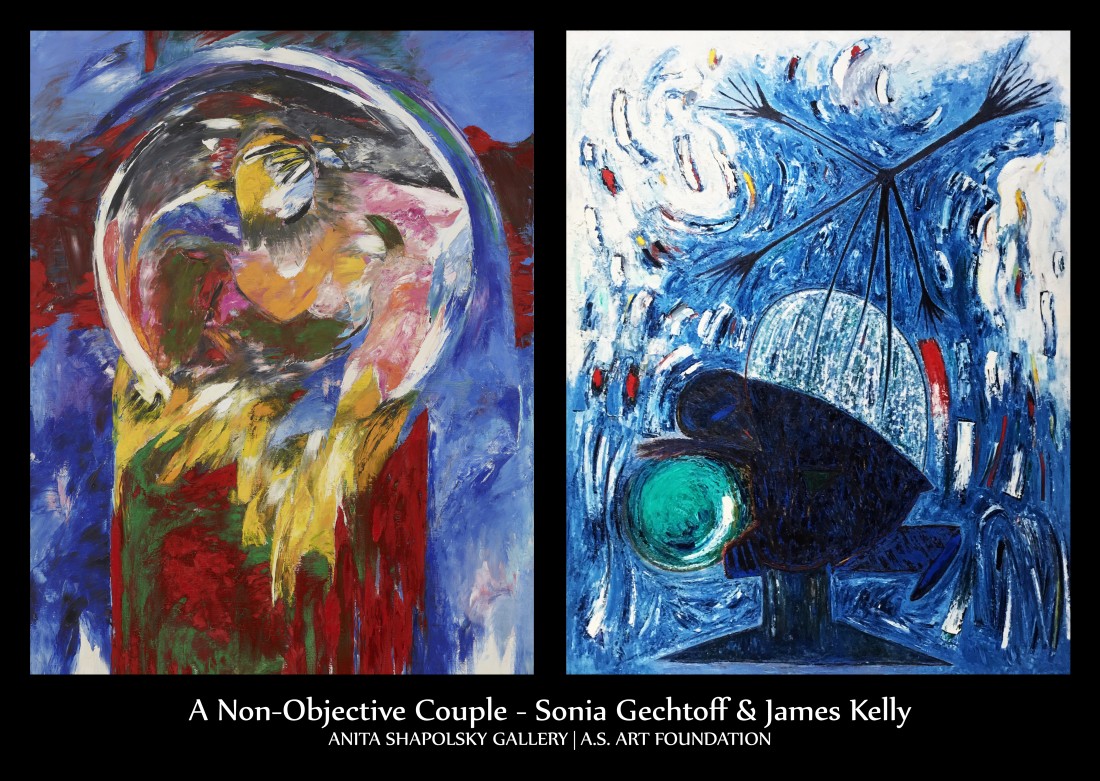
A Non Objective Couple Postcard Front

A Non-Objective Couple
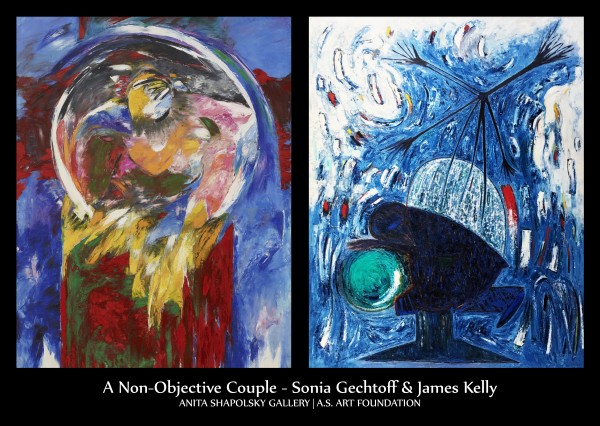
Sonia Gechtoff & James Kelly

May 11th thru July, 2017
Opening Reception: Thursday, May 11th, 6-8pm
Also Opening May 11th: “Sonia Gechtoff – Paper Paintings”

May 11 – June 17 | Anders Wahlstedt Fine Art | 40 East 63rd Street, 3rd Floor New York, NY 10065

The Anita Shapolsky Gallery is pleased to present “A Non-Objective Couple”, an exhibition featuring husband and wife team Sonia Gechtoff and James Kelly. This exhibition features some of the remaining works of these artists’ oeuvres.

As prime examples of the San Francisco School of Abstract Expressionism’s raw, unique influence, Gechtoff and Kelly’s experimental approaches are exemplary of the collective coolness of the Bay Area. A focus on smooth, otherworldly strokes permeate their works, in contrast to the faster movements and more vibrant palette of New York, where much of the cultural dialogue came from and where they eventually settled. Inspired by poetry, particularly by their contemporaries of the Beat generation, Gechtoff, Kelly, and their peers viewed painting as the visual component of literature, yet unlike their New York counterparts, emphasized this duality through allusions to distant figuration, swirling motifs, spiritual encounters, and visual representations of verbal expression in their paintings.

Originally from Philadelphia, Gechtoff and Kelly married in 1953 in San Francisco and moved to a loft on the legendary Fillmore Street, where contemporaries Jay DeFeo, Wally Hedrick, and Michael McClure also lived. They were active participants in the Beat scene, and exhibited at King Ubu Gallery on 3119 Fillmore Street, one of the several locations where the heartbeat pulsed.

Both had a deep affection for the tactile qualities of paint, and a sensual connection to its application, sometimes utilizing their palette knives much like a pastry chef would apply icing to a cake. Sonia Gechtoff was a close friend of Ernest Briggs and Deborah Remington, two acclaimed second generation abstract expressionists. Gechtoff’s later works include loose horizon lines, which the artist says were inspired by her proximity to nature. Her strokes evolved into forms evoking flickering flames, combining her tactile palette-based strokes into more contained compositions.

Kelly’s first encounter with Van Gogh catalyzed his obsession with impasto techniques, which earned him a solid place in the cannon of the time. His handle on physicality, playfulness, and movement, tied to his continuing references to poetic culture, enmeshed him into the dynamic group of second generation abstract expressionists. Many artists in their network would, through sustained exposure to New York’s booming network, relocate eastward towards the end of the 1950’s. They also moved to New York City in 1958.

At 90 years of age, Gechtoff continues her painting and resides in New York City. Throughout their careers, the couple participated actively in not only contributing to the dialogue of 20th century visual art, but cementing the importance of the how influential the West coast Abstract Expressionist scene was to the movement as a whole.

Sonia Gechtoff (b. 1926) is considered one of the most influential female abstract expressionists. Her father was a painter, and introduced her to socialist realism at a young age. In 1950, she completed her BFA at what is now the Pennsylvania Academy of the Fine Arts, and moved to California the following year to study lithography with James Budd Dixon at what is now the San Francisco Art Institute. She was greatly inspired by Clyfford Still. Through her exploration of the movement crafted her signature style; using a loaded palette knife to create vibrant, gestural strokes at large scales. In 1957, she was given her first solo exhibition at the Ferus Gallery in Los Angeles.

In 1958, Gechtoff won a place at the Brussels World’s Fair. She was a recipient of the Pollock-Krasner Foundation Grant in 1989, 1994, and 1998, and received the Lee Krasner Lifetime Achievement Award in 2013. Gechtoff is one of the twelve women featured in the traveling Denver Art Museum exhibition, “Women of Abstract Expressionism”, curated by Gwen Chanzit. Gechtoff is part of numerous museum collections, including the Metropolitan Museum of Art, the Guggenheim Museum, New York, The San Francisco Museum of Modern Art. The Whitney Museum of American Art, and the Denver Art Museum.

James Kelly (1913-2003) had a career which spanned nearly seven decades, including paintings and graphic works. While his work in his native Philadelphia had more of a geometric quality, inspired by Piet Mondrian, his move to California in 1950 changed his style to more gestural, using thick impasto oil paint and swirling motifs common of the San Francisco scene.

Kelly studied at the School of Industrial Arts, and the Pennsylvania Academy of Art, Philadelphia, as well as the Barnes Foundation and the San Francisco Art Institute. He has exhibited widely throughout the United States, and received grants from the Ford Foundation in 1963 and the National Endowment for the Arts in 1977. Kelly’s work is part of many permanent collections including the San Francisco Museum of Art, the Los Angeles Museum of Art, the Harvard University Art Museum, the Pasadena Museum of Art, and the Whitney Museum of American Art.

https://issuu.com/anitashapolskygallery/docs/a_nonobjective_couple_catalog
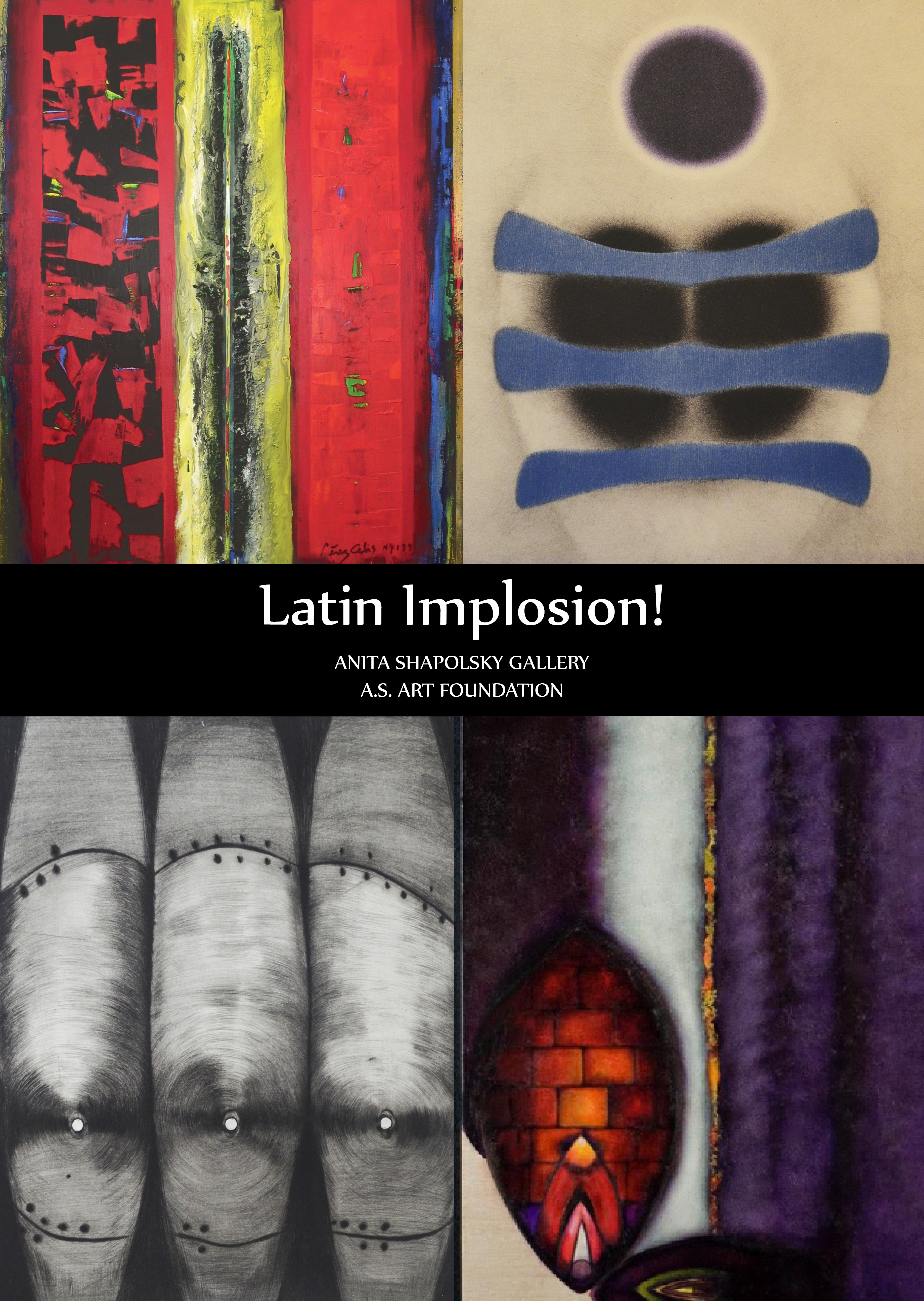
Latin Implosion!

Latin Implosion Postcard Front

Latin Implosion!

March 4 – May 5, 2017
Opening Reception: Tuesday, March 7, 6-8pm
Rodolfo Abularach, Mario Bencomo, Pérez Celis, Agustin Fernandez

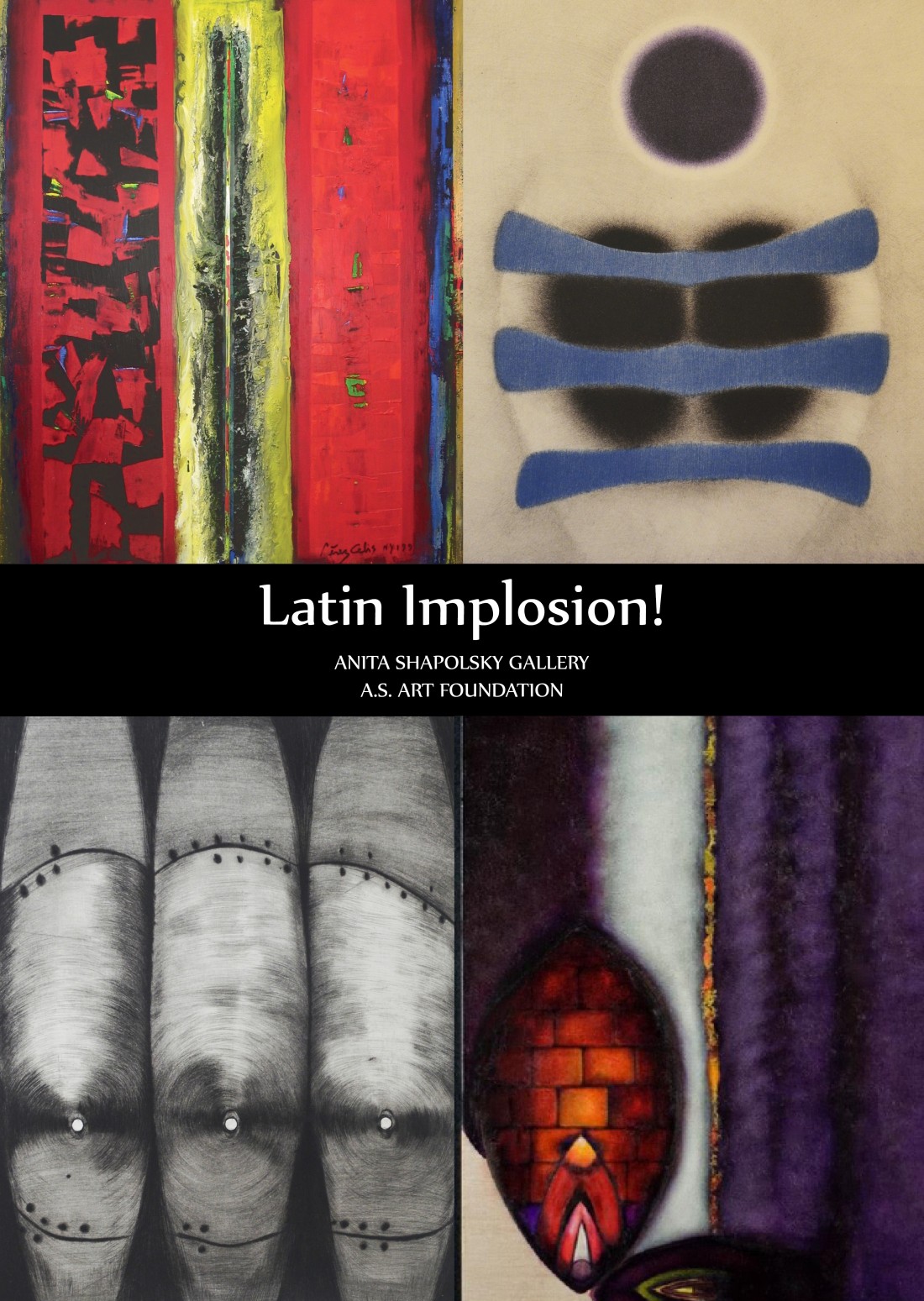
The Anita Shapolsky Gallery is pleased to present “Latin Implosion!” a selection of works by four 20th century masters of Latin American art, including Rodolfo Abularach, Mario Bencomo, Pérez Celis, and Agustin Fernandez. Each of these four artists seeks to explore the sensory overload within each human interaction or experience. Histories of exile, repatriation and diaspora transform the works into vehicles for re-imagining the most intimate aspects of these contested psychic spaces. Each artist depicts their narrative through the gaze of personal mythology and visual language, with the physical and spiritual worlds dancing together within each frame. With “Latin Implosion!”, the gallery is thrilled to continue its legacy as a pioneering space for the exposure and appreciation of the lucid dreamers of Latin America.

Born in Guatemala in 1933 and of Palestinian descent, Rodolfo Abularach is perhaps best known for his close-up depictions of the human eye, yet his slow and mesmerizing abstractions evoke loneliness and introspection. Deviating from universally recognizable figurative works to visceral cellular formations, his pieces maintain a haunting voyeuristic quality, through which the viewer is the object of desire. He studied at the Escuela National de Artes Plásticas in Guatemala City in 1946, and received a grant from the Dirección de Bellas Artes of Guatemala to travel to New York City in 1958, where he began his internationally acclaimed investigations of the eye. Abularach’s works can be found in the collections of the Museum of Modern Art, the Metropolitan Museum of Art, New York, the Museum of Contemporary Art, Sao Paulo, Brazil, and the Royal Museum of Fine Arts, Copenhagen, Denmark, among many others. He is a recipient of the Guggenheim Fellowship for Creative Arts, Latin America and the Caribbean.

Cuban-born Mario Bencomo (b. 1953) blurs the lines between the intuitive and sensual aspects of perception, with references to the animism of the natural world. His playful, colorful realms depict abstractions of feathers, leaves, wings, and their figurative relationships to each other. An avid reader, Bencomo often references poetry in his visual works, as each plane tells an elegant story of symbiosis, pollination, and regeneration. While his paintings utilize a whole spectrum of saturated colors, his works on paper evoke primal energies in simple black and white with deliberately placed color. Mario Bencomo is in many collections, including the Metropolitan Museum of Art, The National Museum of Fine Arts of Havana, Cuba, the Art Museum of the Americas, Washington, D.C., The Norton Museum of Art, West Palm Beach, Florida, and the Muséo de Arte Contemporáneo, Panamá, Panama, among others. He currently resides in Miami, Florida.

A native of Argentina, Pérez Celis (1939-2008) was a colorist who blended raw emotion with piercing planes in a Neo-Expressionist style. His intensity in stroke and layering give his works a striking impact, through which he gained international acclaim. Often referencing his indigenous roots, his paintings, sculptures and murals weave thick tapestries of color with expert compositional fragmentations. Celis’ style evolved during his experiences in the many places he lived, where form and texture-focused works evolved into controlled lines and vibrant colors. Pérez Celis is part of numerous major private collections and museums including the Museum of Modern Art in New York, the Museum of Modern Latin American Art, Nicaragua and Washington, D.C., the Art Museum of Philadelphia, the Museum of Syracuse University, and the National Arts Fund, Buenos Aires, Argentina. In addition, he illustrated Jorge Luis Borges’ translation of the epic Walt Whitman poem, “Leaves of Grass / Ojas de Hierba”, and painted numerous murals on La Bombonera, the home stadium of one of Argentina’s most popular futbol teams, the Boca Juniors. Celis received the Alba Award at the 61st Salón Nacional de Artes Plásticas Argentino in 1972.

Agustin Fernandez (1928-2006) of Cuba settled in New York City in the 1970’s and is often considered a Surrealist for his depictions of fleshy visions and fantastical metallic inventions. His works are directly inspired by the machine, as mechanical joints, fixtures, buttons, and textures permeate his delicately rendered works. The erotic is never understated for Fernandez, as the cold metal hand of industrialization plays tenderly with the flesh in a muted, earthy palette. Fernandez sites exile as being influential in his development as an artist and exploration of more metaphysical realms. Fernandez is currently experiencing a resurgence in popularity, and was recently included in new art fair Paris Internationale in 2016. His work has also been included in numerous collections and group shows at institutions such as New York’s Museum of Modern Art and London’s Victoria & Albert Museum, as well as The Art Institute of Chicago, The Bronx Museum of Art in New York, the Yale University Art Gallery, New Haven, El Museo Nacional de Bellas Artes, Havana, and many more. In 2006, his family established the Agustin Fernandez Foundation, and published “The Metamorphosis of Experience”, a comprehensive survey of his work, in 2012.

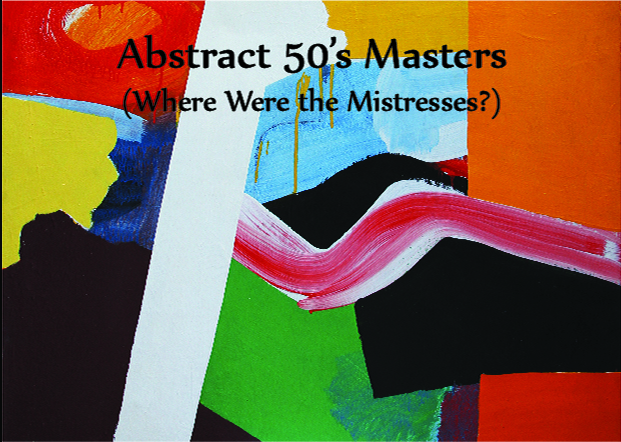
“Abstract 50’s Masters” (Where Were the Mistresses?)

“Abstract 50’s Masters (Where Were the Mistresses?)”

Saturday, November 19th – Saturday, February 25th
Opening Reception:  Saturday, November 19th, 4-6 PM
Panel Discussion: “ Lives of t he Artists”
Spouses, Children & Friends
Saturday, December 10th, 3-5 P M
GALLERY 1:
PETER AGOSTINI, SEYMOUR BOARDMAN, ILYA BOLOTOWSKY, JAMES BROOKS, LAWRENCE CALCAGNO, NASSOS DAPHNIS, BEAUFORD DELANEY, FRIEDEL DZUBAS, JOSEPH FIORE, JOHN HULTBERG, IBRAAM LASSAW, MICHAEL LOEW, LEONARD NELSON, JOE OVERSTREET, PHILLIP PAVIA, MISHA REZNIKOFF, RICHARDS RUBENS, THOMAS SILLS, & WILFRID ZOGBAUM.
GALLERY 2:
ERNEST BRIGGS

Abstract art has roots in the late 19th century and reached ascendance in the late 40’s – 50’s. Philip Pavia (sculptor), one of the leaders of “the Club and his publication “It is” was seminal in the championing of abstract art. Our exhibition emphasizes the pluralistic nature of abstraction: gesture, geometric, and introspection.

Abstract expressionism uses gesture and was an important development in abstract art (Action painting). Most of the artists began traditionally using grids and sketches, as they were taught. They went on to their individual development where the act and thought was important rather than the space that was there. Our artists are considered mainly 2nd generation abstract expressionists. They were lucky to have the guidance of the stars of the first generation. Some of our artists went to the Art Students League and others took classes with the master artists. Many of them belonged to “the Club” and led to the organizing of the Ninth Street show in 1951 which unified the downtown artists and connected them to the public. The annual exhibits continued uptown at the Stable Gallery from 1951-1957.

Gallery 1:
Peter Agostini, Seymour Boardman, Ilya Bolotowsky, James Brooks, Lawrence Calcagno, Nassos Daphnis, Beauford Delaney, Friedel Dzubas, Jimmy Ernst, Joseph Fiore, John Hultberg, Ibraam Lassaw,
Michael Loew, Leonard Nelson, Joe Overstreet, Phillip Pavia, Misha Reznikoff, Richards Rubens,
Thomas Sills & Wilfrid Zogbaum.

Peter Agostini was known as a Plaster Master. He created evocative and lyrical sculptures. The “Saracen” is one of his few bronzes, another copy is in the Smithsonian Museum. Seymour Boardman created contemplative landscapes. His work reduced complicated image to its essence through a simple play with basic color planes while the original background, color lines pierce, bend and twist the negative space. Ilya Bolotowsky was a prolific artist involved in painting, sculptures and mural production. His visually ordered works reveal the influence of Piet Mondrian’s geometry. James Brooks stated that “My painting starts with a complication on the canvas surface, done with as much spontaneity and as little memory as possible. This then exists as the subject. It is as strange as a new still life arrangement as confusing as any unfamiliar situation”. Lawrence Calcagno with the use of linear brush strokes created meditative and colorful landscapes. Nassos Daphnis observed that “nature works in order to create form in an orderly fashion”. His works, often combined exhibited as site-specific installations, mirror nature with a geometric precision. Beauford Delaney’s agitated brushwork, flattened space, and all-over composition were characteristic of contemporary Abstract Expressionism. Friedel Dzubas’s mature paintings since the 1960’s assimilate his early interest in German Romanticism and Expressionism into post-war American abstraction. Jimmy Ernst’s power of composition and paint handling reasserted control over his imagery in later work. Joseph Fiore’s abstractions subtly combine inspirations of a purity that comes from the solitude of the nature environment in Maine. John Hultberg’s dramatic landscapes develop with a prophetic and apocalyptic atmosphere. Ibram Lassaw was an edgy and innovative sculptor whose deft designs open whole spaces into organic systems. Michael Loew’s geometric abstraction retains a sensuous esthetic balance. Leonard Nelson, is known for his gestural abstractions, which he later simplified into color-field paintings. Joe Overstreet integrates painting with sculptural space by combining his materials in different ways. His work thematically challenges dimensional boundaries. Philip Pavia, sculptor, co-founder and director (from 1948 to 1955) of “The Club” emphasizes in his work from abstract marbles through archaic heads in bronze and terra-cotta the relevance between formality, spontaneous gesture and materials. Misha Reznikoff’s piled layers of abstract figures enhance the depth of visual landscapes. Articulate and dynamic brushwork invite the viewer to new vigorous dimensions. Richards Rubens’ series “Venetian Fragments” breaks the dictates of the flat two-dimensional work and remind that he is mainly a gestural artist, who shapes and curves his canvases. Thomas Sills – much of his work embodies a transitional movement between Abstract Expressionism and color field painting. Sills had of many exhibitions at Betty Parsons Gallery. Wilfrid Zogbaum’s dynamic steel structures bear a kinship to primordial ancestors.

Gallery 2:
ERNEST BRIGGS

Ernest Briggs’ volcanic abstract paintings from the 1950’s place him firmly in the ranks of the New York avant-garde. He sought inspiration in nature. The changing qualities of the natural world are conveyed through his ragged and expressive brushwork. A second generation Abstract Expressionist, Briggs represents “action painting.” His paintings are alive; they offer viewers an experience that is both mysterious and known. He participated in several Whitney Museum Annuals and in 1956 was included in the Museum of Modern Art’s exhibition “12 Americans” curated by Dorothy Miller.

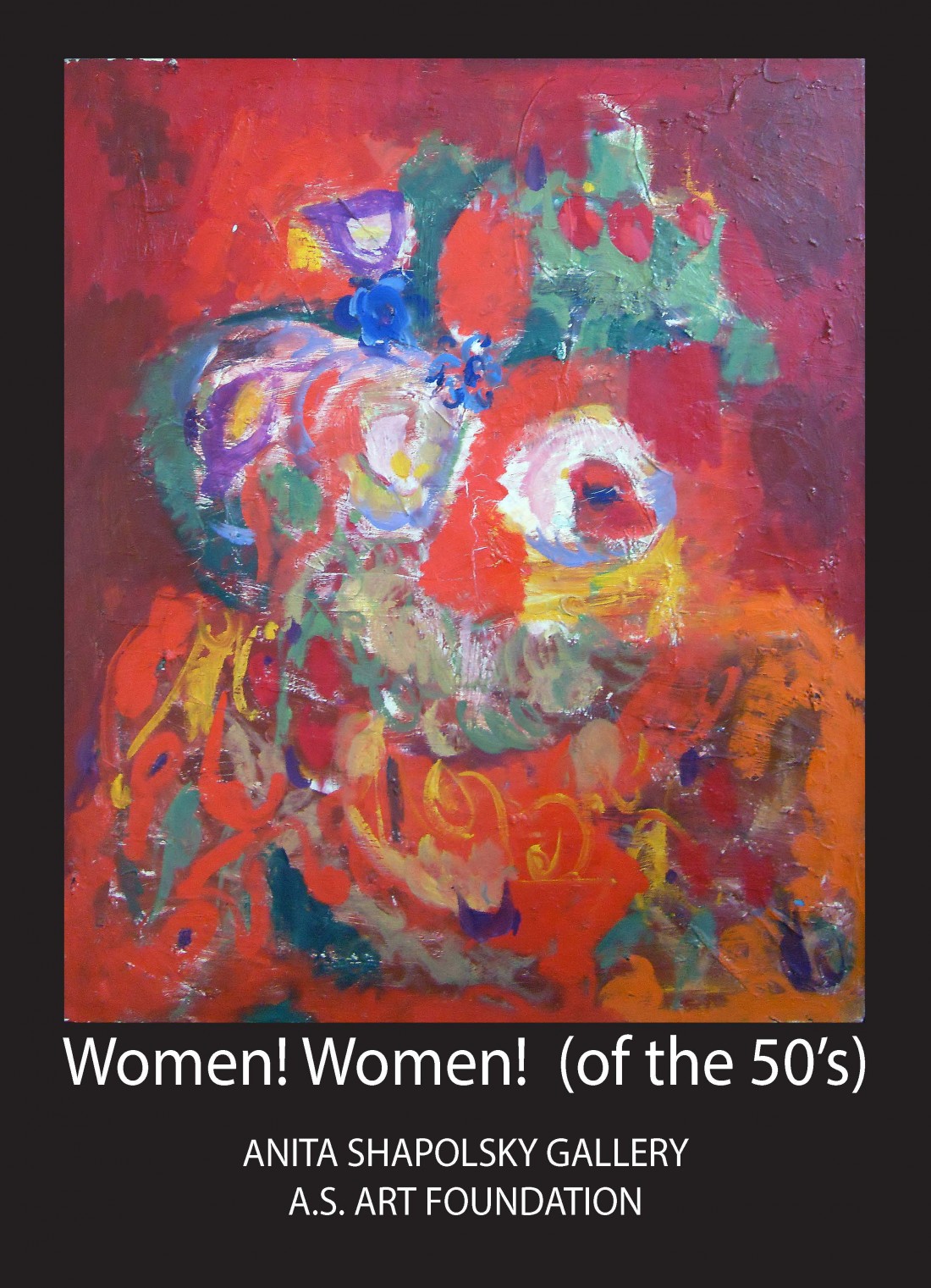
Women! Women! (of the 50’s)

September 15 thru November 12, 2016

Opening Reception: Thursday, September 15th, 6-8 PM

GALLERY 1: ETHEL SCHWABACHER |

GALLERY 2: LYNNE DREXLER, AMARANTH EHRENHALT, CLAIRE FALKENSTEIN, PERLE FINE, SONIA GECHTOFF, GRACE HARTIGAN, BUFFIE JOHNSON, JEANNE MILES, LOUISE NEVELSON, BETTY PARSONS, LIZ WHITNEY QUISGARD, JEANNE REYNAL, YVONNE THOMAS, AND STELLA WAITZKIN


Before any exhibit on “Women” or “Older Artists” was on the horizon, the Anita Shapolsky Gallery celebrated them with the exhibition “Over 85 – Still Creating” (Amaranth Ehrenhalt, 88, Sonia Gechtoff, 89, and Liz Whitney Quisgard, 86) from December 10, 2015 through March 18, 2016.

Sadly, there were no reviews even though our gallery has been in existence since 1982 and we feature abstract artists of the ‘50s.

The Anita Shapolsky Gallery is pleased to present Women! Women! (of the ‘50’s), a comprehensive collection of works by women abstract expressionists who exhibited in the 1950’s. The fifteen women in this exhibition acted as pioneers in their field, each of them carving a unique space in a male-dominated art world. The Anita Shapolsky Gallery has been exhibiting these artists since the ‘80’s. More than sixty years after the emergence of Abstract Expressionism, the art produced by these women remains relevant, modern, and highly individualized. Women! Women! is a celebration of these influential artists. The Gallery is proud and excited to devote a show entirely to showcasing their talents and innovations. Two of the artists in the exhibition, Ethel Schwabacher and Sonia Gechtoff, are currently featured at the Denver Art Museum as a part of its Women of Abstract Expressionism show, which will be traveling for two years. All of the women represented in the show are in major museum collections.

Gallery One will feature the work of Ethel Schwabacher, a New York artist who studied independently under Arshile Gorky. Her surrealist-inspired abstract paintings explore themes of nature, maternity, and psychology. Using a bold palette of complementary colors and loose brushstrokes, Schwabacher’s paintings are explorations of her own psyche. She drew her influences from Greek themes and myths, Freudian theories of dream states and the unconscious, as well as Surrealist canons. More than just a painter, Schwabacher channeled her creativity through writing as well. In 1951, she wrote the catalog for the Whitney Museum’s memorial exhibition for Arshile Gorky, and in 1957 she published the first comprehensive monograph on the artist, which included a biography and her personal critiques. She also published various writings on her own paintings in which she elaborated on her process and motivations.

Gallery Two will display the works of fourteen female abstract expressionists, whose artwork ranges from painting to sculpture to mosaics. Lynne Drexler was a vibrant colorist who favored primary colors. Her short, clustered brushstrokes give the perception of luminosity and airiness. Amaranth Ehrenhalt lived for many years in Paris. Her action paintings appear dynamic and playful, marked by a loose and energetic handling of paint. Emerging from the New York School, Grace Hartigan excelled at finding new approaches for depicting light, space, and form. She was considered one of the most accomplished women painters of her time. Claire Falkenstein and Sonia Gechtoff were both west coast-based artists. Falkenstein was a prominent sculptor, printmaker, painter, and jewelry designer. One of her greatest accomplishments was the construction of The New Gates of Paradise, located at the entrance of the Peggy Guggenheim Museum in Venice, Italy. Gechtoff learned how to paint from her father, and her early works are done in a Social Realist style. Around 1950, however, she familiarized herself with the work of Clyfford Still and became influenced to create highly abstract, large-scale, gestural paintings. Ernest Briggs, a student of Clyfford Still, guided Gechtoff in Still’s unique approach to abstraction. Perle Fine derived much of her inspiration from Hans Hoffman and Piet Mondrian. Consequently, her work is characterized by combining two opposing styles: loose, gestural brushstrokes, with sharp, geometric forms and patterns. Buffie Johnson was a versatile artist who produced a range of styles during her lifetime. The common thread uniting her work is a powerful sense of spirituality, and an intense and focused use of color and form. Also a spiritualist, Jeanne Miles created highly geometric mandalas that reflected her interest in mysticism. Her circular paintings and vivid colors invite the viewer to contemplate universal mysteries. Louise Nevelson is considered one of the most significant American sculptors. Using primarily old pieces of wood and found objects, her abstract arrangements appear complex yet rhythmic. Betty Parsons, thought to be the “godmother of Abstract Expressionism,” created paintings in the fifties that showcased her avant-garde influences from the late forties. Her artistic process went through many evolutions during her career. In the early 1950’s she began making abstract constructions using pieces of wood that she found near her home in Long Island. Liz Whitney Quisgard finds her inspiration from Oriental carpets, Byzantine mosaics, and Navajo textiles. Her final pieces are executed with dazzling pointillism, creating a visual energy out of miniscule details, patterns, and shapes. Jeanne Reynal revolutionized the art of mosaics by thoughtfully leaving spaces of varying widths between the tiles, instilling her pieces with a sense of light. She believed that “the medium of mosaic is not painting with stones and not sculpture, but an art the essential quality of which is luminosity.” Yvonne Thomas was born in France and moved to America to study at Cooper Union, the Art Students League, and the Subject of the Artist school. She studied alongside renowned abstract painters such as Barnett Newman, Mark Rothko, and Robert Motherwell. Her paintings combine aspects of both color field painting and gestural abstraction. Finally, Stella Waitzkin studied painting under Hans Hoffman and Willem de Kooning, however she took her work in another direction. Pursuing her interest in installation art and sculpture, Waitzkin used resin to make molds of objects from her personal life, most often books. By producing beautiful books that could not be read, Waitzkin forced the viewer to reevaluate the object as a more complex, multi-dimensional construction.

Despite their drive and artistic abilities, these women too often slipped into the shadows of their male contemporaries during the height of Abstract Expressionism, which was falsely considered a “man’s movement.” We are delighted to put in the spotlight these artists who were ignobly treated and dismissed for being women, and give them the attention and exposure that they deserve.