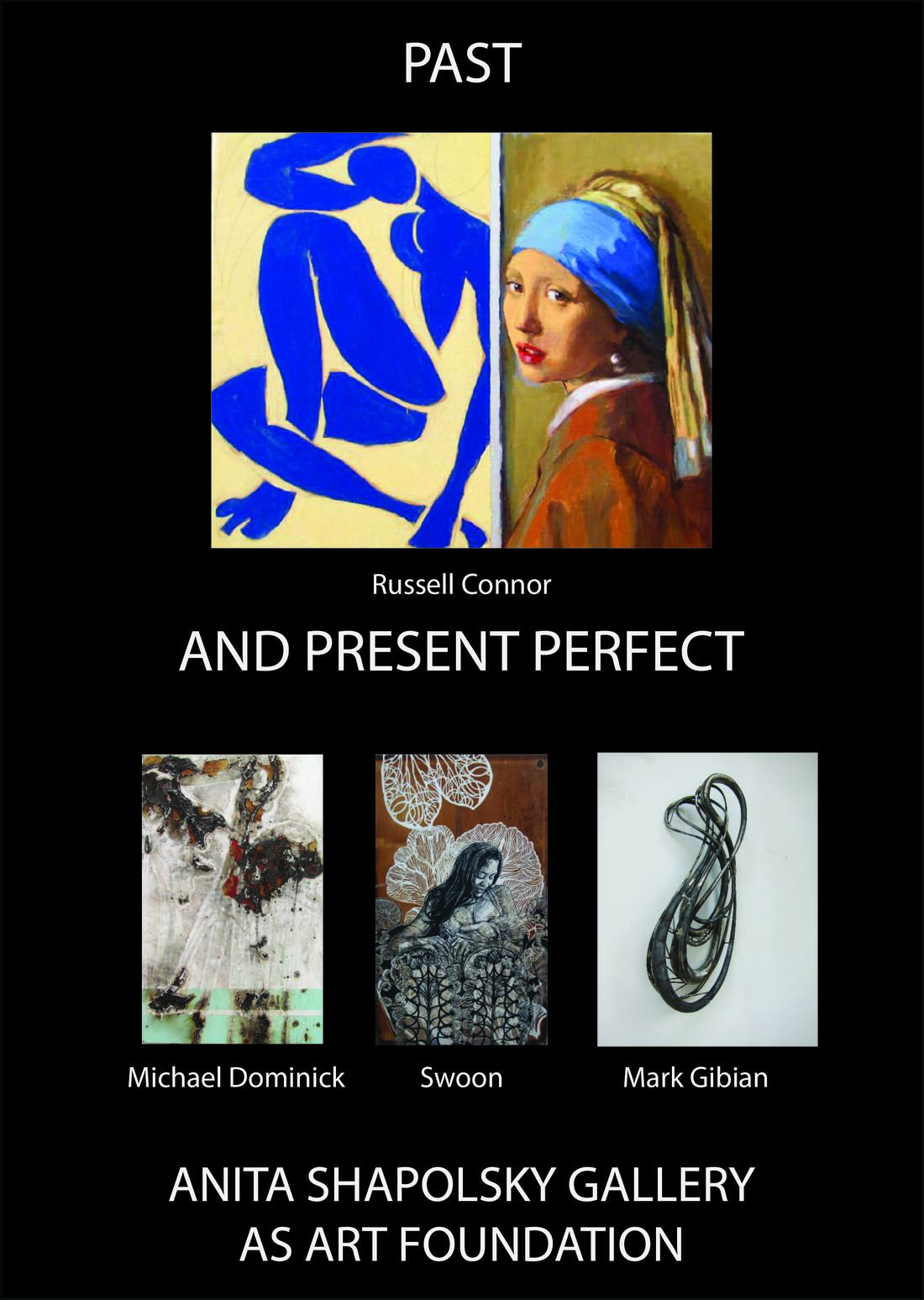
Past & Present Perfect

April 7th – June 13th, 2015

Gallery 1 – Russell Connor
Gallery 2 – Michael Dominick, Mark Gibian & Swoon

Opening Reception: Tuesday, April 7th 6-8pm.

Click Here to see/order the online exhibition catalogue.
Click Here to see the video of the opening reception.

Taking a brief detour from showing Abstract Expressionism, Anita Shapolsky Gallery is proud to present Past and Present Perfect, an exhibition that foregrounds art canon, and highlights historically-informed experimentation with paper, paint, wood, iron, glass, wheat paste and found objects.

Reacting to a widespread lack of proficiency in art history. Past and Present Perfect assembles four artists who study their predecessors and integrate this knowledge into their practice.

On the gallery’s first floor, Russell Connor’s solo show presents selections from his Masters in Pieces series, paintings that playfully juxtapose famous artists, their subjects and iconic paintings from the Western art canon. He explains, “I often look for characters who are gazing intently at something, then I consider what else they might be staring at that would make a surprising story.” Pretending that the Girl with a Pearl Earring is a docent looking over her shoulder and leading us allows Connor to “cast her in the role of international museum guide, and enjoy time travel through art.” His paintings “ask only for some familiarity with the most popular masters and offer fantasy alternatives to the narratives of art history.” He laments, “We have been inundated with classes and reproductions since WWII but still cannot tell a Manet from a Goya,” and it’s in this breach that Connor finds his playground, a playful arena of re-contextualized masterworks, and democratized art history.

Mark Gibian’s sculptures Contraposto, Venus, and Corona conjure art historical memes; respectively, the relaxation of the human stance in Greek sculpture, the female figure as symbol of bounty, and the sun related to royalty or divinity. Gibian’s organic forms of twisted steel, cast bronze and slumped glass openly reveal their manner of support, recalling the interplay between surface and form inherent in Antoni Gaudi’s architecture and Martin Puryear’s sculptures.

Michael Dominick paints with molten iron on paper, carefully keying material to process like Richard Serra, blurring the line between sculpture and painting. Dominick states, “I think of Yves Klein making his fire paintings a lot. And David Smith in Voltri, Italy, having the best time of his life. I think of Pollock too. I think of the guys in the steel mills punching in and out, putting in their eight hours and never considering that someone would want to paint with that liquid fire.

” Best known as a street artist, Swoon pastes screen-printed and paper cutout portraits on found wood and urban buildings. The portraits trace their roots back to Indonesian fabric design and German or Japanese woodblock prints. A composite of carpenter’s finials and a woman’s face in found wood, Swoon’s Ice Queen pays homage to Louise Nevelson.
Forget your unread copy of Janson’s History of Art: The Western Tradition. Follow each artist’s trajectory in Past and Present Perfect backwards from a specific piece to historic masters. Regardless of the current complexity of the art world, art history is alive, present, and the best weapon for clarity.
The Expressive Edge of Paper

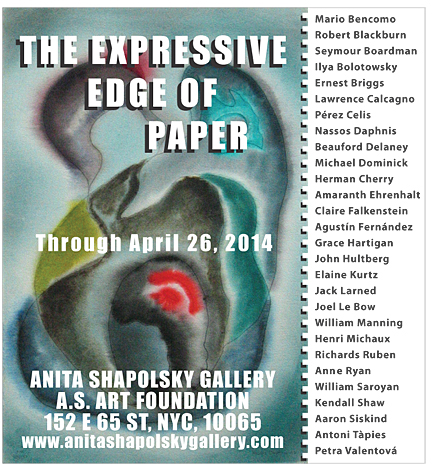
February 22 – April 26, 2014

Karel Appel, Mario Bencomo, Robert Blackburn, Seymour Boardman, Ilya Bolotowsky, Ernest Briggs, Lawrence Calcagno, Pérez Celis, Herman Cherry, Nassos Daphnis, Beauford Delaney, Michael Dominick, Amaranth Ehrenhalt, Claire Falkenstein, Agustín Fernández, Grace Hartigan, John Hultberg, Elaine Kurtz, Jack Larned, Joel Le Bow, William Manning, Clement Meadmore, Melissa Meyer, Henri Michaux, Jeanne Miles, Richards Ruben, Anne Ryan, William Saroyan, Kendall Shaw, Aaron Siskind, Nancy Steinson, Antoni Tàpies, and Petra Valentova.

The Anita Shapolsky Gallery is presenting a multi-faceted group of abstract paper works by twenty-seven artists we have exhibited over the years.  Paper experimentation shows the dichotomy between planning aspects in art and free form automatic drawing.  These works show great technical skill which bring the artists visions to life.  The works give incredible insight into their diverse approaches and the timelessness of their art.  The variety of pieces in this exhibit will be educational and exciting for viewers.  The molten iron paintings by Michael Dominick, for example, result in gestural strokes and splashes, which create beautiful and unpredictable marks that not only scorch the surface but also burn down into the depths of the layered paper.  The abstract photographs of Aaron Siskind evoke wonder at his ingenuity.  Antoni Tàpies’s prints are a good introduction to his ideas for earthly paintings.  Richards Ruben’s oil pastel paintings of Venetian walls on Kochi paper are ethereal.  Agustin Fernandez’s exquisite prints done in Paris by  Lacouriere et Frelaut evoke sensuality using mechanical parts (i.e. screws, pipes, etc.).

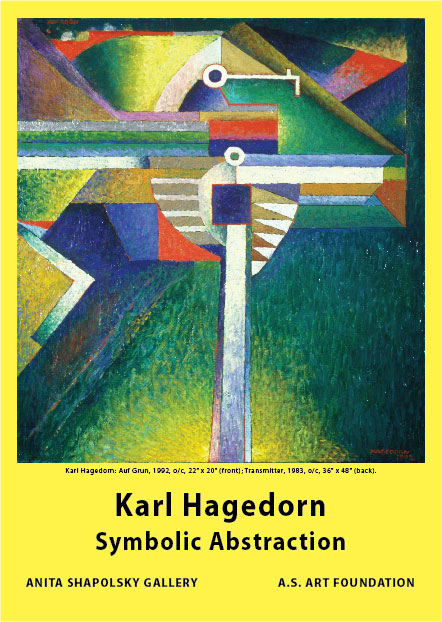
Karl Hagedorn: Symbolic Abstraction

April 17 – August 2012

A native of San Diego, Briggs studied at the California School of Fine Arts in San Francisco (1946-47), the first independent art school outside of New York, where Douglas MacAgy brought together a remarkable faculty including Mark Rothko, Ad Reinhardt, David Park and Clyfford Still. Their influence, in particular, that of his mentor and friend, Still’s visionary aspirations, remained with him for life. In the early 1950s Briggs was pulled along with the Californian diaspora to New York. Almost immediately he was given a one-man show at the Stable Gallery. He developed the rugged California aesthetic into sensual, refined and inviting explosions of paint. He was featured in the “Twelve Americans” exhibition in 1956 at the Museum of Modern Art, curated by Dorothy Miller.

“The discipline to free one’s image from the conventional aspects without surrendering the affirmative drama of human insight to the sterility of decoration or simple design problems has been, and I believe will be, my continuing direction.” (Ernest Briggs, 1956)

“His painting seems to be a process of thoughtful, ruminative adventure. Unlike many of his colleagues in idiom, he does not repeat himself. Each of his canvases strikes in a different direction, but most of them are admirably consistent and well integrated; if you think this type of painting invariably means an unleashed and unconsidered flinging of brushes and pigment, take a good, long look at Briggs and learn your errors.” (Alfred Frankenstein, The San Francisco Chronicle, 1949)

“From the contrast between the surface bravura and the half-seen abstract shapes, a surprising intimacy arises which is like seeing a public statue, thinking itself unobserved, move.” (Frank O’Hara, Art News, May 1954)

“There is a depth and dynamism in Ernest Briggs’ non-objective painting such as is seldom seen in these parts … they have a feeling of flood and sway, of a pouring of forces and tensions across the canvas field. It is as if, to use a slightly mixed metaphor, there were a great wind blowing through all his paintings. There is a kind of dynamism here which gives the effect of living, abstract gesture.” (Lawrence Ferlinghetti, 1953)

“The styl[e] of Briggs … in the fifties does bear a family resemblance to Still’s while differing substantially because of [his] more explicit references to nature, … greater lyricism, and … stress on painterly finesse.” (Irving Sandler, The New York School, 1978)


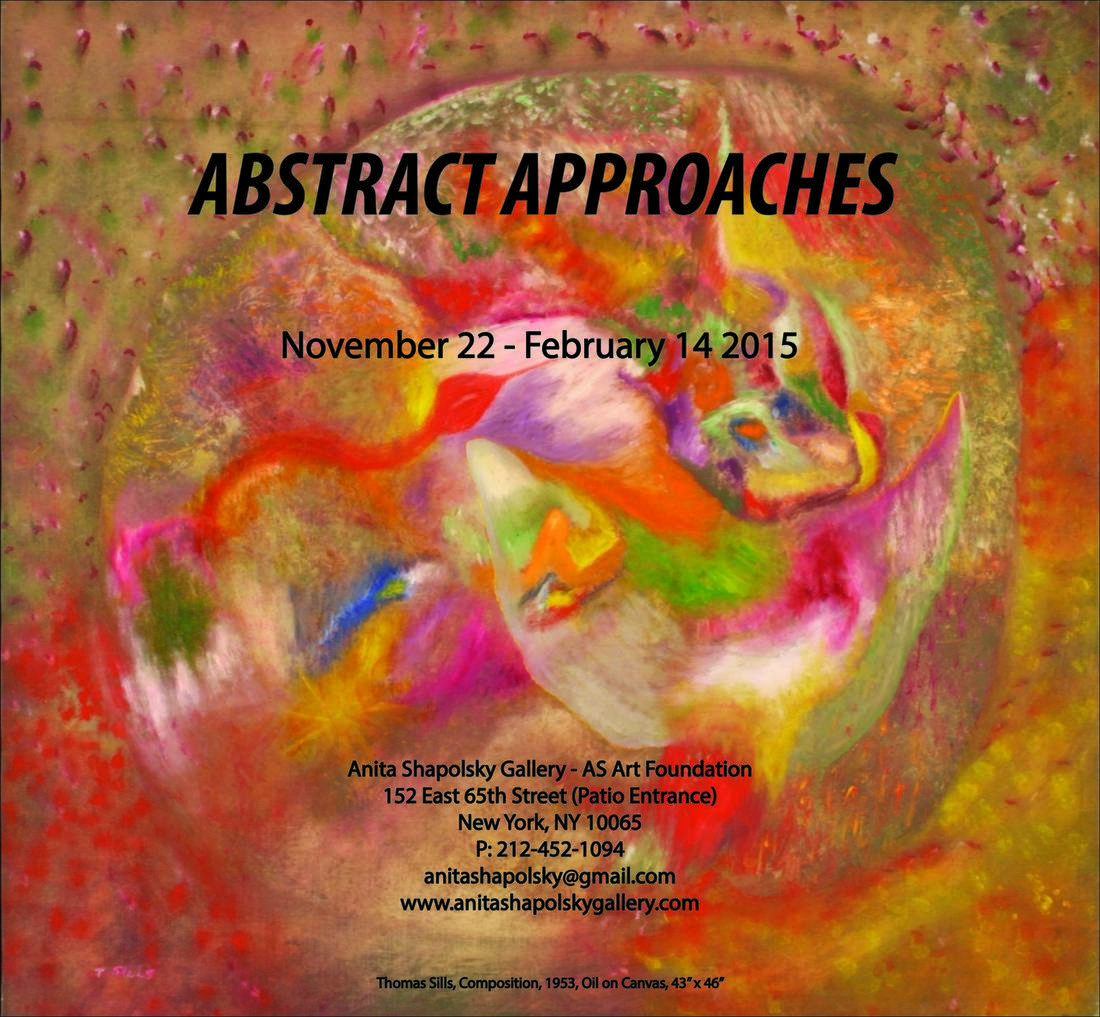
Abstract Approaches

    November 22 – March 28, 2015

Ernest Briggs, Lawrence Calcagno, Friedel Dzubas Amaranth Ehrenhalt, Joseph Fiore, Stanley Hayter, Carl Hecker, Buffie Johnson, Michael Loew, Jeanne Miles, Betty Parsons, Irving Petlin,  Jeanne Reynal, Ethel Schwabacher, Thomas Sills

Click here to see the online catalogue

The Anita Shapolsky Gallery is pleased to present “Abstract Approaches”, a comprehensive collection of many works from the The New York School of the 1950s and 1960s, as well as works as early as 1935 and as recent as 2009. Abstract art means many things. It is not as simple as a room full of gestural paintings, almost indistinguishable from one another. It varies beyond the use of linear shapes and pure geometry. Abstract artists are more complex than one style, or one viable term. This group represents the mecca of this influential art scene, whose tradition has been upheld and continues to be relevant over several decades.

The works exhibited encompass a wide range of approaches that emblematize the Abstract movement. Varying degrees of linearity are shown, as seen in Jeanne Miles’ “The Sound of Children’s Laughter” (1954). Miles work explores the divine and spiritual truths. She encourages the viewer to contemplate universal mysteries. Painterly, loose works with a representational basis are also prominently displayed as seen in Irving Petlin’s “The High Plants” (1969) and Buffie Johnson’s “Cyclical Time” (1962). Irivng Petlin is especially known for his mastery of the pastel medium and often drawing inspiration from poetry. Buffie Johnson’s work is of an existential nature. Johnson’s cosmic like paintings convey her belief in the cylindrical behavior of life with its eternal returns.  The two paintings by Stanley Hayter  “Pavane” (1935), a wooden collage, “Untitled”(1945), an oil painting, are the earliest works in the exhibition. Hayter was associated with the Surrealist movement as well as Abstract Expressionism. He is renowned as one of the most significant printmakers of the twentieth century. The studio he founded in Paris, Atelier 17, is legendary. The inclusion of Jeanne Reynal’s sculpture “Sphere” (1950s) nods to the diversity of mediums employed by this art movement. Reynal adopted the ancient technique of Mosaic in her pieces, and through doing so gave a sense of movement and life to flat surfaces. She used found rocks, stones, shells, marble and other semi-precious stones. She was assisted by her husband (also included in this exhibition) Thomas Sills, who would help her break up stones for her sculptures. Upon meeting Sills, an African American, Reynal left her wealthy husband and the two joined forces in both romance and art making. Thomas Sills’ paintings feature luminous organic forms and innovative compositions in lush fields of color. Carl Hecker, a sculptor, is the youngest artist included in the exhibition. Hecker’s piece “Roadflower with Puddles” (2009) uses synthetic materials and is very playful. Carl fits well in this mix because he was associated with the Martha Jackson Collection with her son David Anderson.

Artists whose works are being shown in this exhibition are pioneers and masters of the Abstract movement. The six women in the exhibition hold their own amongst the men. Betty Parsons, for example, is considered the godmother of Abstract Expressionism and was not only one of the first advocates of many influential artists, but an artist in her own right. Parsons recorded her experiences with nature using radiant luminescence and eventually turned to sculpture using found wood. She made a brave choice in showing other female artists, which at times resulted in males protesting and walking out of her exhibitions. Amaranth Ehrenhalt, another female artist featured in this exhibition, is an incredibly prolific and multidisciplinary artist. Ehrenhalt’s work has been internationally exhibited since the 1950s. Still alive and exhibiting work globally, Ehrenhalt works in painting, sculpture, tapestry, drawings, prints, mosaics, poetry and prose. Ehrenhalt’s work is frenetic, and features a fearless use of color. The dynamic energy of her work transcends to provoke an emotional response from viewers of all backgrounds. The inclusion of her tapestry piece “Aubrietta” (2008) once again enhances the viewer’s sense of the many diverse approaches to abstract art.

  An overarching theme of explorations in nature, light, sensual forms, and cylindrical as well as square shapes is evident in the curation of this exhibition. The many approaches exhibited here shed light on the profound creativity of the abstract artists. What is most exceptional is the ability of these artists to express ideas while treating their subject matter with a tenderness and sensitivity. In today’s art world of constantly changing trends, few movements have stood the test of time, and certainly none can compare.

“ABSTRACT APPROACHES” will be on view at the Anita Shapolsky Gallery at 152 East 65th Street from Nov. 22 – Feb 14, 2014

For additional information and jpegs

 please contact the gallery at

[email protected]