TALL & Small

November 9 – February 11, 2014

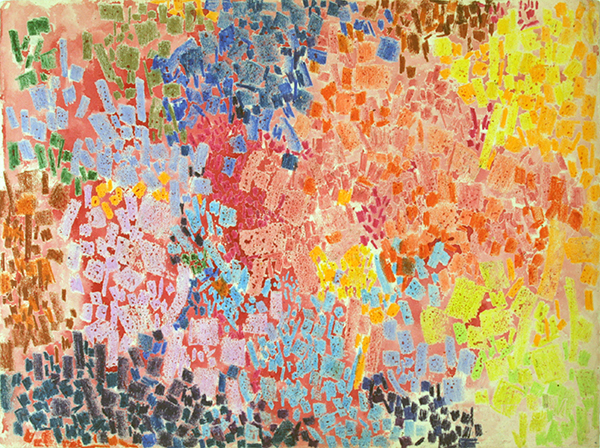
In an increasingly cyber and dot.com world, Abstract Expressionism’s startlingly direct and personal way of communicating looks pretty good.  This exhibition displays the use of various techniques, materials, and different artistic ideas of the second generation of abstractionists.

Seymour Boardman, Ilya Bolotowsky, Ernest Briggs, Lawrence Calcagno, Amaranth Ehrenhalt, Buffie Johnson, Albert Kotin, William Manning, Louise Nevelson, Joe Overstreet, Jeanne Reynal, Ethel Schwabacher, Nancy Steinson, Yvonne Thomas, and Wilfrid Zogbaum.

Seymour Boardman‘s work reduced complicated image to its essence through a simple play with basic color planes while the original background, color lines pierce, bend and twist the negative space.  Ilya Bolotowsky’s visually ordered works reveal the influence of Piet Mondrian’s geometry.  Ernest Briggs’s non-representational compositions of pure and emotional colors explode with inviting gesture to emerge in their powerful intimate world. Lawrence Calcagno with the use of linear brush strokes created meditative and colorful landscapes.  Amaranth Ehrenhalt, an ‘action painter’, presents us with dynamic, colorful and playful works.  Buffie Johnson represented existentialist work among Abstract Expressionists; her cosmic-like paintings convey her belief in the cycle of life with its eternal returns.  Al Kotin’s phantasmagoric combination of color initiates an illusion of slowly rotating motion.  William Manning’s pieces unfold in a way that is reminiscent of the Cubists ideas about fragmented vision.  Louise Nevelson’s signature is a complex arrangements of abstract shapes enclosed in boxes.  Joe Overstreet integrates painting with sculptural space using meaning-laden materials that reference both painting and the human condition.  Jeanne Reynal through her “direct method” adapted the luminosity of ancient mosaics into abstract mosaic compositions.  Ethel Schwabacher’s paintings combine automatism, introduced to her by Arshile Gorky, with abstract forms, referring to nature.  Nancy Steinson’s sculptures add to the richness of the exhibition.  Yvonne Thomas is best conveyed through a play of muted brushstrokes that transgress the substantiality of matter.  Wilfrid Zogbaum’s dynamic steel structures bear a kinship to primordial ancestors.
 

The Hard Line

THE HARD LINE

Seymour Boardman, Ilya Bolotowsky, Nassos Daphnis, Kendall Shaw

September 11 – November 15, 2014

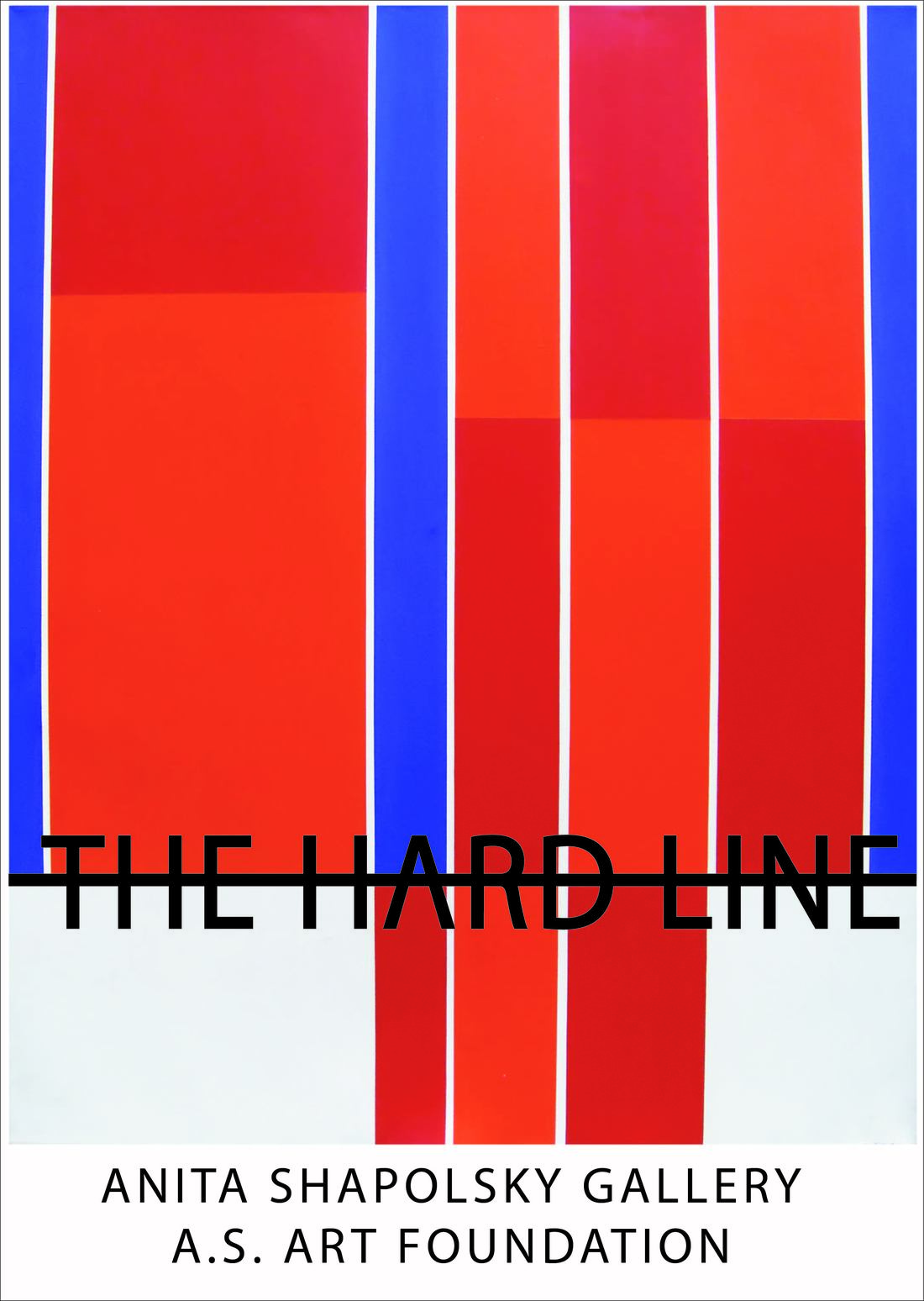
The Anita Shapolsky Gallery is presenting an exhibit of four artists renowned for their contributions to hard-edged works in which color is primary. The approach of Seymour Boardman (1921-2005) to visual structure evolved from his earlier works which evidenced a concern with expressive painted surfaces. After losing the use of his left hand during World War II, Boardman resumed his art studies in France from 1946-1949. “Visual structure” played a major role in his approach. Boardman moved from the use of gestural paint strokes to formally composed canvases that are specific in the use of color, shape placement, and line. In his acrylic 1961 Untitled (72” x 38”), Boardman places his shapes at the bottom of the rectangular canvas, interacting with both the space above and the actual bottom edge of the painting. He engages the spectrum of black by using two variations-each marked by different intensities and richness. Over a decade later, in the 1978 acrylic Untitled (26” x 34”) he uses only lines to explore the vastness of his white color field. Boardman’s work is included in the collections of the Brooklyn Museum, Newark Museum, Rose Art Museum, Guggenheim Museum, Whitney Museum and other more.

A founding member of the American Abstract Artists (1936), a group that rejected the popular realist imagery of the day, Ilya Bolotowsky (1907-1981) was one of the few artists to create an abstract mural for the WPA.  His biomorphic forms gave way to the grids, shaped canvases, and the use of primary colors interacting with white space – which operate as bands or lines. Bolotowsky was influenced by his countryman Kazimir Malevich, and when he first saw the paintings of Piet Mondrian in 1933, he was strongly impacted by the ideology of Neo-Plasticism. In the 1958 Naples Yellow and Grey (26” x 34 ½”), Bolotowsky delivers a nuanced work, without the use of primary colors. Instead, he punctuates gradations of white, greys, and the warmth of Naples Yellow with slender rectangles of aqua blue, dusty rose, and bluish purple – all of equal intensities. Bolotowksy’s work is included in the collections of the Art Institute of Chicago, San Francisco Museum of Art, Philadelphia Museum of Art, Hirshhorn Museum, the Guggenheim Museum – (where he had a retrospective in 1974) and other public institutions.

The creative journey of Nassos Daphnis (1914- 2010) took him from early paintings recalling his youth in Greece, to the City Walls Project in the Manhattan of the 1970’s. His abstract, geometric images adorned building walls from the West Side Highway to Madison Avenue and 26th Street. Daphnis first showed at the Leo Castelli Gallery in 1959. His ouvre included the exploration of geometric planes of color, often arranged in patterns. He then morphed to a wide-ranging examination of circles, discs, rings, and spheres. The latter he explored in three-dimensional epoxy on novaply (a form of particle board). In PX-9-69 (30” x 30”) from 1969, Daphnis uses enamel on a circular plexiglass field to explore the push and pull of movement via both color and shape. The black and red motif uses missile-like forms to converge on a central black diamond. Simultaneously, bands of blue, yellow, and white both push towards the center while alluding to the space beyond the perimeters of the canvas. Daphnis is included in the collections of the Aldrich Museum, Museum of Modern Art, and Chrysler Museum and many others.

Emanating from an extensive background in science, specifically physics, Kendall Shaw (b.1924) has consistently been concerned with the metaphysics of art. Throughout his career, color and space have been primary. In his Cajun Minimalist series, Shaw uses panels of acrylic on canvas—placed to interact with the white wall space—to illustrate his philosophy of color as energy. In his 2012 Alligator Kum, Shaw employs four panels of color, two narrow and two wide. The narrow red and orange bands are separated by a span of white wall, equal in measure to them. The result is a shifting and ongoing dialogue. Shaw’s work is in the collection of the Brooklyn Museum of Art, the Museum of Contemporary Art in Japan, and the New Orleans Museum of Art.

All four artists reduced complicated image to its essence through a simple play with basic color planes. For additional information and jpegs, please contact the gallery at: [email protected]


LITTLE GEMS – Small Paintings and Paper Pieces

“LITTLE GEMS”
Small Paintings and Paper Pieces

August 25 – October 15, 2011

Mario Bencomo, Seymour Boardman, Ilya Bolotowsky, Ernest Briggs, Gandy Brodie, James Brooks, Lawrence Calcagno, Perez Célis, Herman Cherry, Beauford Delaney, Lynne Drexler, Amaranth Ehrenhalt, Grace Hartigan, Buffie Johnson, Andrey Klasson, Martee Levi, Michael Loew, William Manning, Jeanne Miles, Joan Mitchell, Betty Parsons, Richards Ruben, William Saroyan, Ethel Schwabacher, Aaron Siskind, Charmion Von Wiegand, and Wilfred Zogbaum.

The Anita Shapolsky Gallery presents a charming show as the summer draws to a close. The exhibition of small paintings and paper pieces adhere to the gallery’s focus of abstract expressionist style, but offers an eclectic variety of genre, medium and eras. It exposes rare drawings, prints, photographs and paintings from some of the most significant artists of the 1950’s and 1960’s. This show follows our tradition of representing important artists from all backgrounds to the public.

Amaranth Ehrenhalt – A Hidden Treasure

October 22, 2011 – January 31, 2012

Amaranth Ehrenhalt’s colorful and dynamic Abstract Expressionist style, manifested over decades in various mediums, will be on display at the Anita Shapolsky GalleryOctober 22nd through January 2012. Born in Newark, New Jersey and educated at the Pennsylvania Academy of the Fine Arts in Philadelphia, Ehrenhalt’s career has spanned decades of art movements. Her adventurous spirit led her to Paris where she met and exhibited with several expatriate artists of the abstract New York School, including Sam Francis, Joan Mitchell and Shirley Jaffe. On the eve of her departure for Paris, Ehrenhalt met de Kooning for a drink at the legendary Cedar Tavern; the dinner they planned upon her return never happened, as it wasn’t until 2008 that she came back to New York permanently.

Lyrical, intuitive and generous in her creative process, Ehrenhalt lives and thinks her art. Known for her spontaneous style, her work retains parallels to the automotive modes of the surrealists.1 

The use of vibrant and warm colors in works such as “Jump In and Move Around” from 1962 has also invited comparisons to the ‘sensual colorist traditions’ of the European modernists.2 Joseph Hirshhorn described Ehrenhalt as developing ‘her own language,’ while her lingering interest in organically drawn lines has at times insinuated “a new, possibly eerie, form of figuration.”3 Though her work has transformed over the years, it maintains the lush colors, bustling compositions and variegated layers of depth characteristic of her style. Ehrenhalt’s adept straddling of many influences, from Paris-based Abstract Expressionism to early Modernism via her education at the Barnes Foundation (Cezanne, Renoir, Matisse), imbues her work with palpable energy and excitement. Ehrenhalt displays the self-reflexivity common to the second generation of American abstract artists. Listed among her early influences are El Greco, Giotto, Cimabue, Kandinsky and Jackson Pollock, artists who impacted her aesthetic. In this regard, she embodies a common sentiment felt by her contemporaries; as Robert Motherwell once said, “every intelligent painter carries the whole culture of modern painting in his head.”4 One of the last painters of her generation still working, she has been called “a living treasure of American abstract art.”5 Whether on canvas, mosaic, print-making or designing tapestries, Ehrenhalt ardently and passionately continues her exploration of animated abstraction, much in the same way the late painter Lucien Freud never tired of figuration.

The visual cornucopia that is the work of Amaranth Ehrenhalt renders it fascinating to the viewer time and time again. Collectors form intimate and ongoing relationships with her paintings and find them rejuvenating, even after years of looking at and living with them. In the same way her works impart their viewers with unexpected and evolving interpretations, Ehrenhalt’s dialogue with modern abstract painting is an ongoing and open-ended endeavor. Like that second drink she never managed to have with de Kooning, the serendipity and joy evident in Ehrenhalt’s work inspires the imagination in the same manner as the continually unfolding narrative of her storied career.

1 Beatrice Comte, Le Figaro, Paris: October 17, 1998.
2 Sandra Kraskin, Encore, Exhibition catalog, New York: Sidney Mishkin Gallery, Baruch College, 2006.
3 John Ashbery, International Herald Tribune, Paris: October 3rd, 1962.
4 Mary Ann Caws and Robert Motherwell, Robert Motherwell: What Art Holds, New York: Columbia Univ.: 34.
5 Richmond Shepard, Arts Editor, Diplomatic World Bulletin, New York: March 1998.